
12.9. 语义分割和数据集
在 12.3节— 12.8节中讨论的目标检测问题中,我们一直使用方形边界框来标注和预测图像中的目标。 本节将探讨语义分割(semantic segmentation)问题,它重点关注于如何将图像分割成属于不同语义类别的区域。 与目标检测不同,语义分割可以识别并理解图像中每一个像素的内容:其语义区域的标注和预测是像素级的。 图12.9.1展示了语义分割中图像有关狗、猫和背景的标签。 与目标检测相比,语义分割标注的像素级的边框显然更加精细。
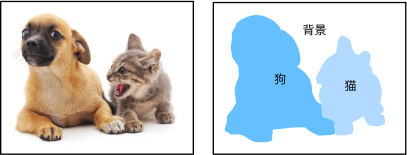
图12.9.1 语义分割中图像有关狗、猫和背景的标签
12.9.1. 图像分割和实例分割
计算机视觉领域还有2个与语义分割相似的重要问题,即图像分割(image segmentation)和实例分割(instance segmentation)。 我们在这里将它们同语义分割简单区分一下。
图像分割将图像划分为若干组成区域,这类问题的方法通常利用图像中像素之间的相关性。它在训练时不需要有关图像像素的标签信息,在预测时也无法保证分割出的区域具有我们希望得到的语义。以 图12.9.1中的图像作为输入,图像分割可能会将狗分为两个区域:一个覆盖以黑色为主的嘴和眼睛,另一个覆盖以黄色为主的其余部分身体。
实例分割也叫同时检测并分割(simultaneous detection and segmentation),它研究如何识别图像中各个目标实例的像素级区域。与语义分割不同,实例分割不仅需要区分语义,还要区分不同的目标实例。例如,如果图像中有两条狗,则实例分割需要区分像素属于的两条狗中的哪一条。
12.9.2. Pascal VOC2012 语义分割数据集
最重要的语义分割数据集之一是Pascal VOC2012。 下面我们深入了解一下这个数据集。
%matplotlib inline
import os
import albumentations as A
import mlx.data as dx
import numpy as np
from d2l import mlx as d2l
数据集的tar文件大约为2GB,所以下载可能需要一段时间。
提取出的数据集位于../data/VOCdevkit/VOC2012。
#@save
d2l.DATA_HUB['voc2012'] = (d2l.DATA_URL + 'VOCtrainval_11-May-2012.tar',
                           '4e443f8a2eca6b1dac8a6c57641b67dd40621a49')

voc_dir = d2l.download_extract('voc2012', 'VOCdevkit/VOC2012')
进入路径../data/VOCdevkit/VOC2012之后,我们可以看到数据集的不同组件。
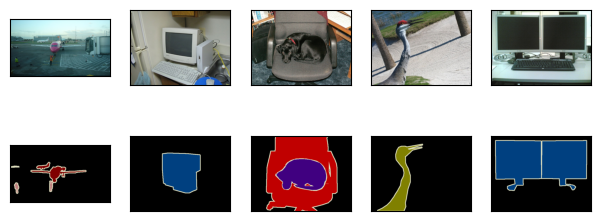
ImageSets/Segmentation路径包含用于训练和测试样本的文本文件,而JPEGImages和SegmentationClass路径分别存储着每个示例的输入图像和标签。
此处的标签也采用图像格式,其尺寸和它所标注的输入图像的尺寸相同。
此外,标签中颜色相同的像素属于同一个语义类别。
下面将read_voc_images函数定义为将所有输入的图像和标签读入内存。
#@save
def read_voc_images(voc_dir, is_train=True):
    """读取所有VOC图像并标注"""
    txt_fname = os.path.join(voc_dir, 'ImageSets', 'Segmentation',
                             'train.txt' if is_train else 'val.txt')
    data = []
    with open(txt_fname, 'r') as f:
        images = f.read().split()
    for i, fname in enumerate(images):
        image_path =  os.path.join(voc_dir, 'JPEGImages', f'{fname}.jpg')
        label = os.path.join(voc_dir, 'SegmentationClass', f'{fname}.png')
        data.append(
            dict(image=image_path.encode("ascii"), label=label.encode("ascii"))
        )
    dataset = dx.buffer_from_vector(data)
    dataset = dataset.load_image("image").load_image("label")
    feature = [data["image"] for data in dataset]
    label = [data["label"] for data in dataset]
    return feature, label

train_features, train_labels = read_voc_images(voc_dir, True)
下面我们绘制前5个输入图像及其标签。 在标签图像中,白色和黑色分别表示边框和背景,而其他颜色则对应不同的类别。
n = 5
imgs = train_features[0:n] + train_labels[0:n]
d2l.show_images(imgs, 2, n);
接下来,我们列举RGB颜色值和类名。
#@save
VOC_COLORMAP = [[0, 0, 0], [128, 0, 0], [0, 128, 0], [128, 128, 0],
                [0, 0, 128], [128, 0, 128], [0, 128, 128], [128, 128, 128],
                [64, 0, 0], [192, 0, 0], [64, 128, 0], [192, 128, 0],
                [64, 0, 128], [192, 0, 128], [64, 128, 128], [192, 128, 128],
                [0, 64, 0], [128, 64, 0], [0, 192, 0], [128, 192, 0],
                [0, 64, 128]]

#@save
VOC_CLASSES = ['background', 'aeroplane', 'bicycle', 'bird', 'boat',
               'bottle', 'bus', 'car', 'cat', 'chair', 'cow',
               'diningtable', 'dog', 'horse', 'motorbike', 'person',
               'potted plant', 'sheep', 'sofa', 'train', 'tv/monitor']
通过上面定义的两个常量,我们可以方便地查找标签中每个像素的类索引。
我们定义了voc_colormap2label函数来构建从上述RGB颜色值到类别索引的映射,而voc_label_indices函数将RGB值映射到在Pascal
VOC2012数据集中的类别索引。
#@save
def voc_colormap2label():
    """构建从RGB到VOC类别索引的映射"""
    colormap2label = np.zeros(256 ** 3, dtype=np.int32
                              )
    for i, colormap in enumerate(VOC_COLORMAP):
        colormap2label[
            (colormap[0] * 256 + colormap[1]) * 256 + colormap[2]] = i
    return colormap2label

#@save
def voc_label_indices(colormap, colormap2label):
    """将VOC标签中的RGB值映射到它们的类别索引"""
    colormap = np.array(colormap).astype('int32')
    idx = ((colormap[:, :, 0] * 256 + colormap[:, :, 1]) * 256
           + colormap[:, :, 2])
    # print("idx:\n", idx)
    return colormap2label[idx]
例如,在第一张样本图像中,飞机头部区域的类别索引为1,而背景索引为0。
y = voc_label_indices(train_labels[0], voc_colormap2label())
y[105:115, 130:140], VOC_CLASSES[1]
(array([[0, 0, 0, 0, 0, 0, 0, 0, 0, 1],
        [0, 0, 0, 0, 0, 0, 0, 1, 1, 1],
        [0, 0, 0, 0, 0, 0, 1, 1, 1, 1],
        [0, 0, 0, 0, 0, 1, 1, 1, 1, 1],
        [0, 0, 0, 0, 0, 1, 1, 1, 1, 1],
        [0, 0, 0, 0, 1, 1, 1, 1, 1, 1],
        [0, 0, 0, 0, 0, 1, 1, 1, 1, 1],
        [0, 0, 0, 0, 0, 1, 1, 1, 1, 1],
        [0, 0, 0, 0, 0, 0, 1, 1, 1, 1],
        [0, 0, 0, 0, 0, 0, 0, 0, 1, 1]], dtype=int32),
 'aeroplane')
12.9.2.1. 预处理数据
在之前的实验,例如 8.1节—
sec_googlenet中,我们通过再缩放图像使其符合模型的输入形状。
然而在语义分割中,这样做需要将预测的像素类别重新映射回原始尺寸的输入图像。
这样的映射可能不够精确,尤其在不同语义的分割区域。
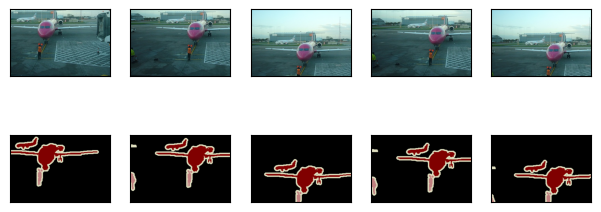
为了避免这个问题,我们将图像裁剪为固定尺寸,而不是再缩放。
具体来说,我们使用图像增广中的随机裁剪,裁剪输入图像和标签的相同区域。
#@save
def voc_rand_crop(feature, label, height, width):
    """随机裁剪特征和标签图像"""
    transform = A.RandomCrop(height=height, width=width, p=1)
    transformed = transform(image=feature, mask=label)
    cropped_feature = transformed['image']
    cropped_label = transformed['mask']
    return cropped_feature, cropped_label
imgs = []
for _ in range(n):
    imgs += voc_rand_crop(train_features[0], train_labels[0], 200, 300)

d2l.show_images(imgs[::2] + imgs[1::2], 2, n);
12.9.2.2. 自定义语义分割数据集类
我们通过继承高级API提供的Dataset类,自定义了一个语义分割数据集类VOCSegDataset。
通过实现__getitem__函数,我们可以任意访问数据集中索引为idx的输入图像及其每个像素的类别索引。
由于数据集中有些图像的尺寸可能小于随机裁剪所指定的输出尺寸,这些样本可以通过自定义的filter函数移除掉。
此外,我们还定义了normalize_image函数,从而对输入图像的RGB三个通道的值分别做标准化。
#@save
class VOCSegDataset():
    """一个用于加载VOC数据集的自定义数据集"""

    def __init__(self, is_train, crop_size, voc_dir):
        self.transform = A.Normalize(
            mean=[0.485, 0.456, 0.406], std=[0.229, 0.224, 0.225])
        self.crop_size = crop_size
        features, labels = read_voc_images(voc_dir, is_train=is_train)
        self.features = [self.normalize_image(feature)
                         for feature in self.filter(features)]
        self.labels = self.filter(labels)
        self.colormap2label = voc_colormap2label()
        print('read ' + str(len(self.features)) + ' examples')

    def normalize_image(self, img):
        img = img.astype(np.float32) / 255
        return self.transform(image=img)['image']

    def filter(self, imgs):
        return [img for img in imgs if (
            img.shape[0] >= self.crop_size[0] and
            img.shape[1] >= self.crop_size[1])]

    def __getitem__(self, idx):
        feature, label = voc_rand_crop(self.features[idx], self.labels[idx],
                                       *self.crop_size)
        return (feature, voc_label_indices(label, self.colormap2label))

    def __len__(self):
        return len(self.features)
12.9.2.3. 读取数据集
我们通过自定义的VOCSegDataset类来分别创建训练集和测试集的实例。
假设我们指定随机裁剪的输出图像的形状为\(320\times 480\),
下面我们可以查看训练集和测试集所保留的样本个数。
crop_size = (320, 480)
voc_train = VOCSegDataset(True, crop_size, voc_dir)
voc_test = VOCSegDataset(False, crop_size, voc_dir)
read 1114 examples
read 1078 examples
设批量大小为64,我们定义训练集的迭代器。 打印第一个小批量的形状会发现:与图像分类或目标检测不同,这里的标签是一个三维数组。
#@save
def create_voc_data_iter(voc_dataset, batch_size, shuffle=True, drop_last=True):
    """创建VOC数据集的迭代器"""
    if drop_last:
        num_batches = len(voc_dataset) // batch_size
    else:
        if len(voc_dataset) % batch_size == 0:
            num_batches = len(voc_dataset) // batch_size
        else:
            num_batches = len(voc_dataset) // batch_size + 1

    data = []
    for i in range(len(voc_dataset)):
        feature, label = voc_dataset[i]
        if drop_last and i > num_batches * batch_size:
            break
        data.append({"X": feature, "y": label})

    dataset = dx.buffer_from_vector(data)
    data_iter = (
        dataset
        .shuffle_if(shuffle)
        .to_stream()
        .batch(batch_size)
    )
    return data_iter, num_batches

batch_size = 64
train_iter, num_batches = create_voc_data_iter(voc_train, batch_size, shuffle=True,
                                    drop_last=True)
for samples in train_iter:
    X = samples["X"]
    Y = samples["y"]
    print(X.shape)
    print(Y.shape)
    break
(64, 320, 480, 3)
(64, 320, 480)
12.9.2.4. 整合所有组件
最后,我们定义以下load_data_voc函数来下载并读取Pascal
VOC2012语义分割数据集。 它返回训练集和测试集的数据迭代器。
#@save
def load_data_voc(batch_size, crop_size):
    """加载VOC语义分割数据集"""
    voc_dir = d2l.download_extract('voc2012', os.path.join(
        'VOCdevkit', 'VOC2012'))
    train_iter, num_train_batches = create_voc_data_iter(
        VOCSegDataset(True, crop_size, voc_dir), batch_size,
        shuffle=True, drop_last=True)
    test_iter, num_test_batches = create_voc_data_iter(
        VOCSegDataset(False, crop_size, voc_dir), batch_size,
        drop_last=True)
    return train_iter, num_train_batches, test_iter, num_test_batches
12.9.3. 小结
语义分割通过将图像划分为属于不同语义类别的区域,来识别并理解图像中像素级别的内容。
语义分割的一个重要的数据集叫做Pascal VOC2012。
由于语义分割的输入图像和标签在像素上一一对应,输入图像会被随机裁剪为固定尺寸而不是缩放。